Reading Yuganta: The End of an Epoch felt like a long, quiet conversation about the Mahabharata.
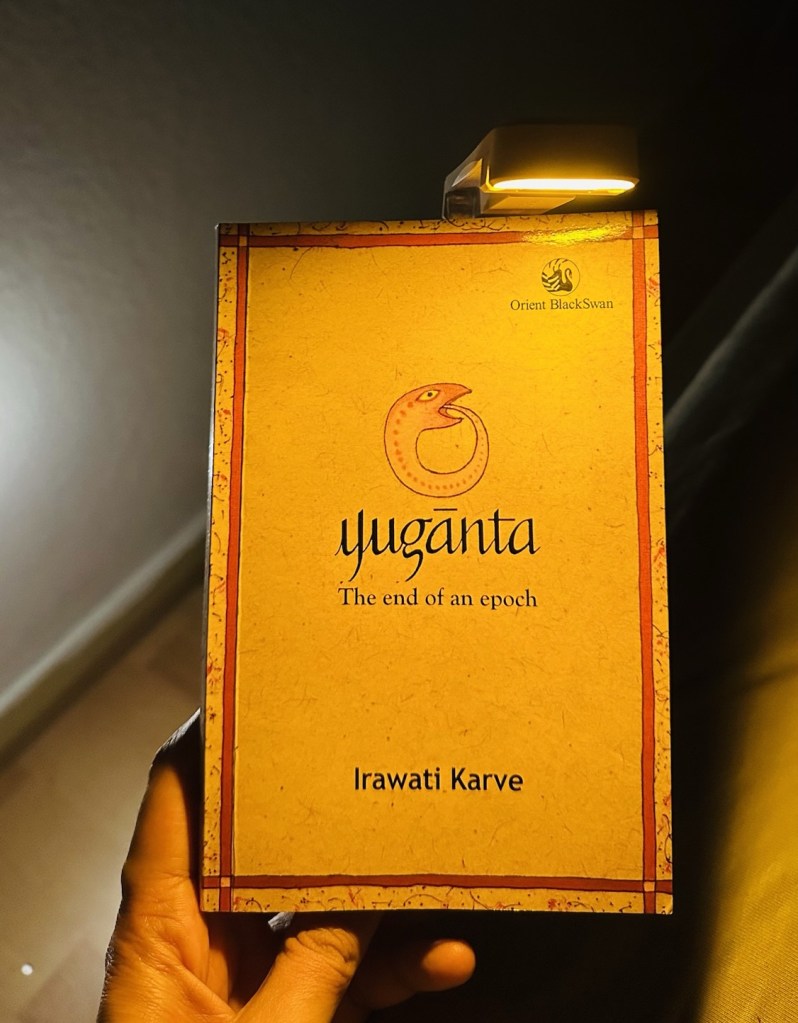
I went into it thinking I knew the epic. But this book didn’t retell the story. It made me pause, question, and sometimes feel uncomfortable about the characters I thought I understood.
Karve doesn’t treat them as gods or larger-than-life heroes. She looks at them as people—shaped by their circumstances, their choices, and their limitations. And somehow, that doesn’t diminish them. It actually makes them more real.
While reading Bhishma, I felt the weight of rigid vows. With Gandhari, I felt that silent anger and how it can quietly shape outcomes. Draupadi left me conflicted—she is intelligent and strong, but I kept wondering if her expression of that strength sometimes led to consequences she couldn’t control. That unease stayed with me.
Vidura stood out in a different way. He represents values, clarity, and truth—but without power or recognition. It made me think about how often quiet correctness goes unnoticed, while flawed characters become unforgettable.
Karna’s chapter hit deeply. He felt like someone constantly searching for belonging, and when he finally had a chance to claim it, he chose not to. His loyalty to Duryodhana is admirable, but also tragic. It made me wonder how much of our identity we build around our struggles, and how hard it is to let that go.
And then came Krishna.
Before reading this, I always had a slightly conflicted view of him—especially around the idea of strategy and politics. But Karve’s perspective felt different. She doesn’t present him as a God in the traditional sense, but as someone with clarity and detachment. He is involved in everything, yet not emotionally entangled. His actions don’t feel like manipulation—they feel purposeful. That clarity made it easier to respect him without hesitation.
The last chapter, Yuganta, ties everything together. It is filled with insight, but I’ll be honest—it felt dense. There is so much to take in that reading it in one go felt overwhelming. I found myself needing to pause often, not because it was difficult, but because it had so much to offer.
What stayed with me the most is this: the book does not diminish the Mahabharata or its characters. Instead, it opens another window. You begin to see the same story in a different light—more human, more complex, and closer to reality.
Reading is subjective, and this book definitely made me feel a lot—confusion, admiration, unease, and clarity at different points. But that’s exactly why it worked for me.
Yuganta doesn’t replace the epic. It enriches it.
If you’re someone who is interested in the Mahabharata and are open to seeing it from a different perspective, this is definitely worth reading.
This post is a part of BlogchatterA2Z Challenge 2026
──────── ★ ────────
 Chai and Chatter Chronicles
i am surely intrigued and might as well buy the copy now. This “It made me think about how often quiet correctness goes unnoticed, while flawed characters become unforgettable.” is such a reality. Even in our lives we encounter it.
LikeLike