I recently finished reading The Seven Dials Mystery and then moved on to watching its screen adaptation—and the experience has been fascinating in a very unique way. It feels like watching someone else’s imagination take over a story you’ve already built in your own head.
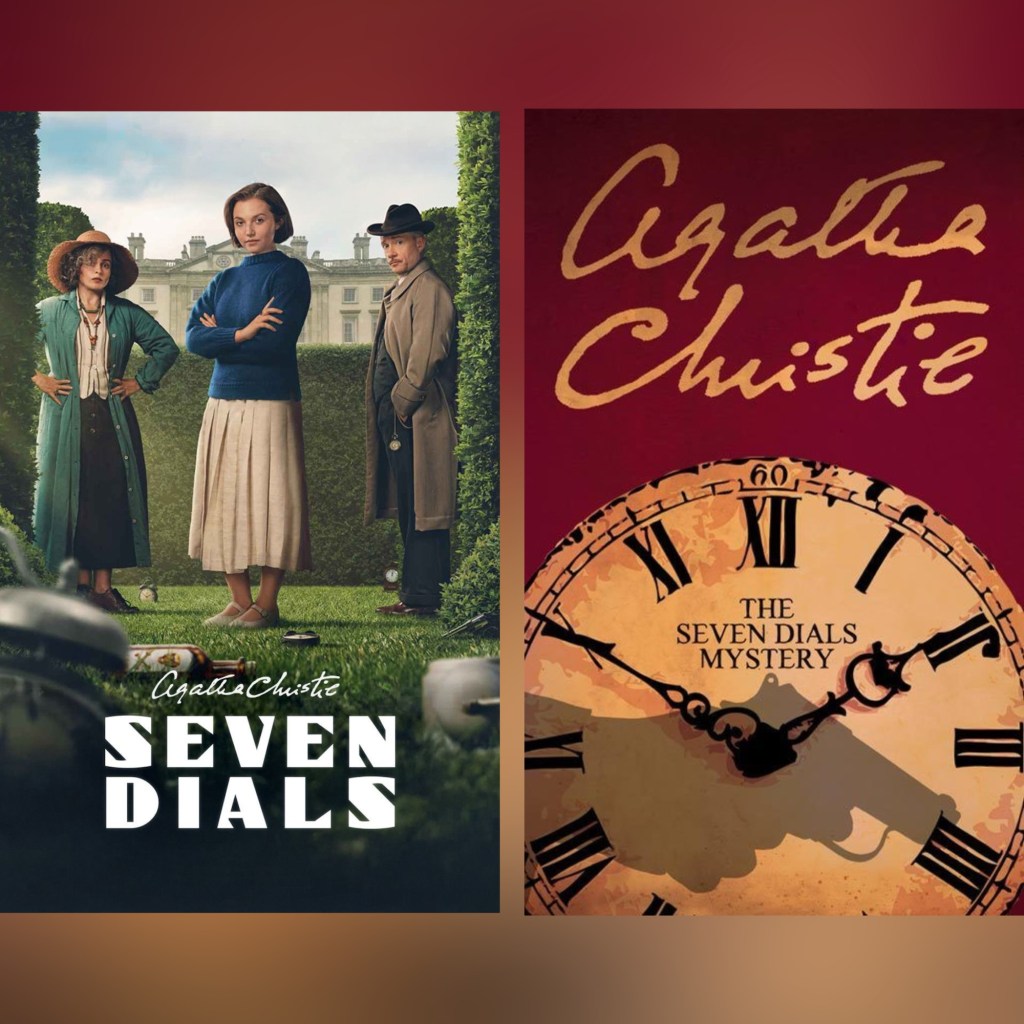
That gap between reading and watching is where things get interesting. And Slightly annoying too.
One of the first things I noticed was how differently the characters are treated. In the book, there’s a certain balance—everyone has a role in the larger puzzle. But in the series, that balance shifts. Characters like Battle don’t feel as central, and that subtly changes the foundation of the mystery. New story line in movie fits the puzzle well.
Jimmy, for me, is where the difference hits hardest. In the novel, he has this playful, slightly careless charm—the kind of character who doesn’t seem entirely serious until things take a darker turn. In the series, though, he feels more serious from the beginning, which flattens that transformation. The emotional impact just isn’t the same. No spoiler here. So, not sharing anymore about the Jimmy.
Then there’s Lady Coote. She comes across as much braver and more assertive on screen than in the book. It’s not necessarily a bad change—it actually works well for television—but it does shift the tone. The social nuances Christie plays with become more direct, less ironic.
And perhaps the most noticeable change: Bundle and Wade being engaged. That single decision alters the entire dynamic. In the book, relationships feel fluid, almost casual, which gives Bundle a kind of freedom—she moves through the story driven by curiosity and instinct. In the series, that freedom is replaced with a sense of emotional grounding. She’s still active, but her motivations feel more structured, less impulsive.
What’s really happening here is a shift in storytelling style. The book feels like a mix of mystery and social playfulness—light in tone but sharp underneath. The series, on the other hand, leans into drama. Relationships are more defined, emotions are clearer, and the ambiguity is reduced.
That said, one thing the adaptation does really well is dialogue. There’s a noticeable effort to capture the rhythm of 1920s England—the politeness, the wit, the subtle tension beneath everyday conversation. It adds authenticity, even when the characters themselves feel different.
And the setting—the post–World War I atmosphere—is handled with care. You can feel that in-between world: a society still holding onto its old structures, but quietly shifting underneath. That backdrop gives both the book and the series their unique flavor, even if they express it in different ways.
In the end, watching the adaptation isn’t about comparing it line by line with the book. It’s more like seeing how the same story evolves when someone else interprets it. Some things are lost, some are gained—but it’s never exactly the same story twice.
And maybe that’s the point.
This post is a part of BlogchatterA2Z Challenge 2026
──────── ★ ────────
 Chai and Chatter Chronicles